I remember a project in Kyiv where almost every customer came through Instagram.
The company sold disposable packaging to restaurants, cafés and small food producers. The owner had a decent audience and plenty of enquiries. From the outside, things looked fine. But when we looked at how those enquiries were actually handled, the picture was different.
Almost every conversation started the same way.
- “Do you have this size?”
- “How much for 100 pieces?”
- “What about 500?”
- “How much is delivery?”
The owner answered most of these questions himself. If he was busy, people waited. Some came back later. Some didn’t.
That was when we started discussing an online store.
Social media is useful — but it shouldn’t be the whole sales system
I have worked with websites and online sales for more than ten years, and I have changed my opinion about social media a few times.
At first, I thought businesses should simply move as much activity as possible to their websites. Then social platforms became much better at selling products, and I had to admit that I was partly wrong.
Instagram can be extremely good at attracting attention.
A good photograph, a short video or a recommendation from another person can bring dozens of potential customers in a day. There is no need to pretend otherwise.
The problem starts later.
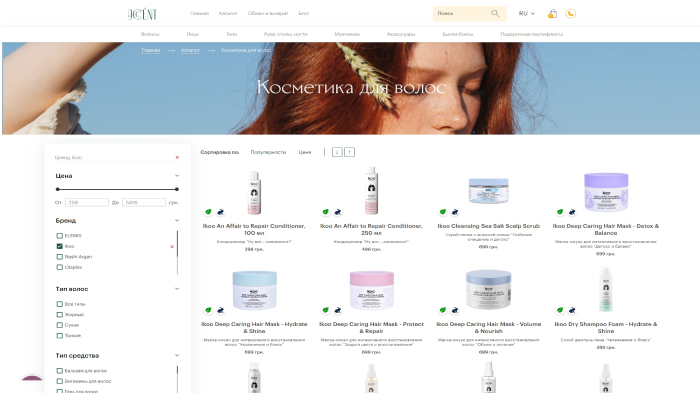
A social media profile is not particularly convenient when someone wants to look through 40 products, compare sizes, check stock, read delivery conditions and finally place an order.
The customer has to ask.
Someone has to answer.
And if that someone is the business owner, the system becomes rather fragile.
What changes with online store development
This is where online store development becomes interesting.
A properly built store takes some of the routine work away from people. Product information is available at any hour. Prices don’t have to be typed into every conversation. Customers can move from one product to another without scrolling through months of posts.
It sounds obvious.
Until you actually count the conversations.
In the Kyiv project I mentioned earlier, we didn’t build anything exotic. There were product categories, individual product pages, prices, delivery information and a straightforward order form.
The owner initially wanted a complicated catalogue with filters for almost everything. We removed several of them.
Why?
Because customers didn’t use them.
That was one of those small decisions that looks insignificant in a project plan but makes the finished website much easier to use.
After the store had been running for several months, a noticeable part of the orders started coming directly through the website. The owner still used Instagram every day, but now Instagram was sending people somewhere useful instead of becoming the place where every sale had to be negotiated manually.
One practical rule: let social media create interest, but give the customer a simple place where they can actually buy.
An online store also gives you something social networks don’t
Control.
You decide how products are organised. You decide what information appears first. You can change the structure, add landing pages, improve product descriptions and work with Google search.
That last part is particularly important for businesses with a large product range.
A post on Instagram may be forgotten after a few days. A well-made product page can continue bringing visitors from search engines months later.
Of course, a website doesn’t magically produce sales. I have seen expensive stores that looked impressive but generated almost nothing because nobody had thought about search demand, navigation or the actual buying process.
So I’m not suggesting replacing social media with a website.
I’d use both.
When it makes sense to order online store creation
If you sell three products and receive five orders a month, an online store may be unnecessary.
But if customers repeatedly ask the same questions, your product range is growing, you are spending money on advertising, or you want traffic from Google, the situation changes.
This is when order online store creation starts making practical sense.
Social media can bring the customer to you.
Your own store can make sure the customer doesn’t have to wait for you before buying.
And, honestly, that difference becomes very noticeable once the number of orders stops being small.